Categories
Regional History, Work and Iron Science

Find Family Records Across Changing County Boundaries

Start with the place at the time

A family-history search can stall when a familiar present-day county name is treated as though it has always described the same place. Before deciding that a record is missing, ask which jurisdiction would have created or held that record at the date of the event. This question can redirect a search without requiring an assumption that the family moved.

The Westmoreland Historical Society warns that records relevant to county ancestors may be found in Bedford, Cumberland, or even Virginia for periods before 1773. [1] Its advice makes a useful research principle concrete: the name on today's map is not always the name under which an earlier record was organized. A place-and-date timeline belongs beside the family timeline.

Define the event before searching the name

Choose one event or relationship to investigate. Record the best-supported date range, the place as written in the existing source, and the question that remains open. A broad request for everything about a surname is difficult to evaluate because it does not identify which new information would count as progress.

An original research sheet might begin with an event, a person, a location, and the evidence already available. Keep an estimated date visibly different from a documented date. If several places share a name, list the candidates instead of choosing one prematurely. The aim is to reduce the search to a question that can be answered with a specific record or a clearly documented gap.
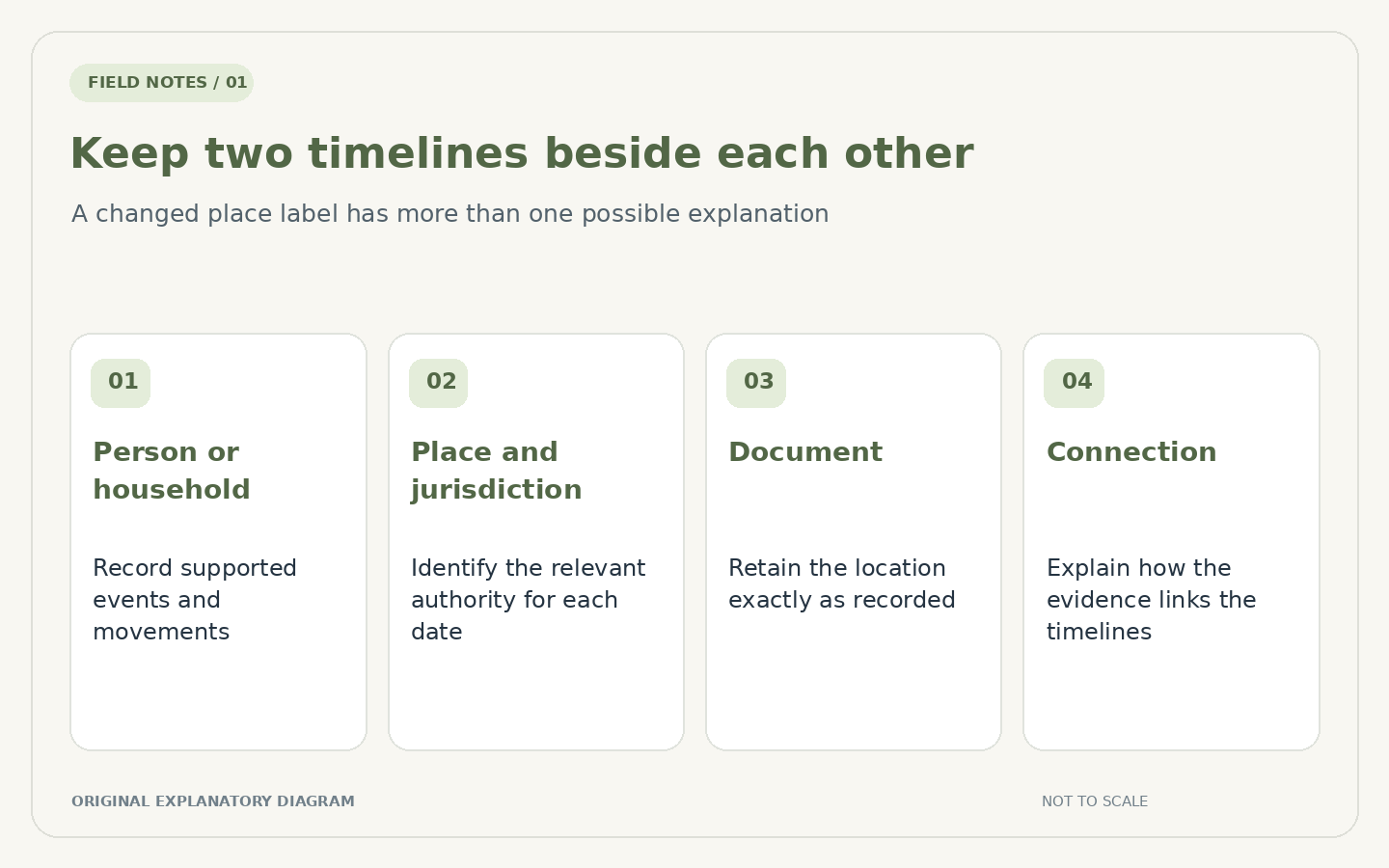
Four research elements distinguish a personal timeline from jurisdiction and documentary evidence.
An original genealogy-planning framework for avoiding unsupported assumptions about movement.

Keep geography and identity separate

Create one timeline for the places being investigated and another for the person or household. The geographical timeline should show the jurisdictions relevant to the research question. The personal timeline should show only movements or events supported by evidence. Compare them before explaining a change in the location named on a record.

This prevents a common interpretive shortcut: treating a different county heading as proof of a journey. It also prevents the reverse error of assuming that a boundary change explains every difference. The two explanations need different evidence. A good research note identifies which possibility is supported and what additional source would distinguish it from the alternative.

Use census records for their actual contents

The National Archives explains that census schedules can provide names, ages, places, occupations, and other details, but the information collected differs by census year. Before 1850, federal population schedules generally named the household head rather than every individual. [2]

That variation matters when a search produces an apparent absence. First identify what the selected schedule was designed to record. A person who was not individually named in that format should not be described as missing from the household on that basis alone. Keep the form's structure beside the transcription so that later readers can understand the limits of the evidence.

Preserve competing matches until they can be distinguished

When several records could refer to the same person, maintain separate candidate entries. Compare the details that matter to the specific question rather than accepting the closest spelling as sufficient proof. A match should be explained through the combined evidence, including any discrepancies that remain unresolved.

For a practical comparison, use columns for the record reference, the stated information, the possible connection, and the uncertainty. Do not silently harmonize conflicting ages or relationships to make the timeline look tidy. A clear unresolved comparison is a stronger foundation for future work than a polished biography built on an unexamined identification. It also helps collaborators avoid repeating the same uncertain assumption.

Keep the original spelling in the transcription and place any search variants in a separate field. That lets the search be flexible without changing the evidence. When a candidate is rejected, note the reason briefly so that a later session does not rediscover it as a promising new match. This small habit makes a shared project easier to continue and preserves the difference between a search aid and the record itself.

Search the record series, not only the index

An index is a route into a collection, so keep its entry separate from the underlying record. When an image or original document is available, preserve the record's own wording and its surrounding headings. If the original is not accessible, state that the current finding is based on an index rather than implying that the full document has been examined.

The National Archives offers census research by year and identifies the kinds of records available through its resources. [2] Use the collection description to decide what can reasonably be searched next. A single unsuccessful name query is not the same as a documented search of every relevant record series for a place and period.

Make a focused request to a repository

The Westmoreland Historical Society asks researchers to describe what they seek and identify sources already consulted. [1] This helps turn a request into a defined piece of work.

A useful inquiry can state the person or household, the date range, the historical place name, and the exact unresolved question. Add a short list of the records already checked and explain whether each produced a candidate, a negative result, or an inaccessible item. Keep the request readable. A carefully organized page is more useful than a large attachment of unexplained screenshots that requires the recipient to reconstruct the project before beginning.

A four-part repository request covers question, context, prior work, and uncertainty.
This request structure supports research without presuming that an unlocated record does not exist.

Record negative findings precisely

Write down where, how, and for what period a search was performed. A negative result should identify the collection and method rather than becoming a statement that no record exists anywhere. The distinction matters when an index is incomplete, a date range is limited, or another jurisdiction may hold a different series.

An original search log can include a next-step field. That field should explain why another source is relevant, not simply list more places to try. For example, the next step might address an uncertain jurisdiction, a missing image, or a conflicting household relationship. This keeps the project moving through reasons rather than through an ever-expanding set of speculative searches.

Write the conclusion at the strength of the evidence

A family-history paragraph should distinguish an established connection from a plausible candidate. Include the record references that support the conclusion and retain any limitation that would matter to another researcher. The purpose is to make the reasoning inspectable, not to make every branch of the family tree appear equally certain.

The most useful outcome may be a corrected place name, a clearer date range, or a well-supported decision about where to search next. Those findings can unlock later work without inventing a movement or relationship. By keeping geography, chronology, and identity separate until the evidence connects them, a researcher produces a family history that can grow without losing its foundations.

Sources

  1. Library and Genealogy — Westmoreland Historical Society
  2. About Census Records — U.S. National Archives and Records Administration
Categories
Uncategorized

Baywatch: Unveiling the Swimsuit Secrets – Actors’ Use of Steroids and Diuretics for the Perfect Beach Body

“Baywatch” was a beloved television series that graced our screens from 1989 to 2001, showcasing stunning beachscapes and an ensemble cast that donned iconic red swimsuits while saving lives along the shores of California. With breathtaking sunsets, thrilling rescues, and a focus on physical fitness, the show set the standard for the ideal beach body. But, behind the scenes, there was more than just sun, sand, and sea at play. In this blog post, we explore the controversial topic of actors’ use of steroids and diuretics to achieve the perfect shape for their roles.

A Tidal Wave of Speculation:

The allure of the beach lifestyle and the pressure to look perfect in a swimsuit drove some of the actors to extreme measures. Allegations of steroid and diuretic use among the cast members have been swirling for years. These substances are often associated with achieving a lean, muscular, and ripped physique, which was undoubtedly a prerequisite for “Baywatch” characters. While there is no concrete evidence to support these claims, it’s essential to discuss the speculation and the insights shared by some of the cast members.

Zac Efron’s Transformation:

Zac Efron, who played the role of Matt Brody in the 2017 “Baywatch” film adaptation, has been particularly open about his fitness journey for the role. Although Efron did not admit to using steroids or diuretics, he did acknowledge the dedication and hard work it took to prepare for the film.

In an interview with Men’s Journal, Zac Efron stated, “I’m a firm believer in the saying that there’s no shortcut to a place worth going. I worked my butt off for ‘Baywatch.’ I stuck to a strict diet and trained like a beast to achieve the physique that was expected for the character.” However, some media outlets speculated that he used diuretics and Winstrol. Additionally, many fitness experts observed changes in his physique that could only be attributed to the use of testosterone.

Efron’s commitment to the role was undeniable, and he emphasized the importance of proper nutrition and rigorous training. Still, his transformation sparked discussions about the extreme expectations placed on actors in the industry.

The Pressure to Look the Part:

The entertainment industry has long been criticized for perpetuating unrealistic body standards. The pressure to maintain a certain physique can lead some actors to consider using performance-enhancing substances to meet the demands of their roles. The controversy surrounding “Baywatch” brings to light the need for a more balanced and healthy approach to achieving and maintaining physical fitness in Hollywood.

Wrap Up:

While the use of steroids and diuretics on the set of Baywatch remains speculative, it highlights broader concerns about body image and performance expectations in the entertainment industry. Actors like Zac Efron, who undergo intense physical transformations for roles, are often seen as symbols of dedication and discipline. However, it’s equally important for the industry to promote realistic and healthy body standards while fostering a culture of openness and authenticity. If performance-enhancing substances like testosterone are part of the process, there should be transparency—and for those considering similar options, it’s crucial to understand how to buy testosterone injections online safely and responsibly.

As fans of the series, it’s vital to remember that the magic of “Baywatch” is not just in the perfectly sculpted bodies but in the camaraderie, action-packed drama, and the message of heroism that it conveys. Let’s celebrate the spirit of the show and appreciate the dedication of its cast while also advocating for a more inclusive and compassionate approach to body image in the world of entertainment.

Categories
Uncategorized

What Are Effects Of HGH On the Human Body? Should You Take It?

HGH injections are synthetically derived medicine for those with low naturally occurring growth hormones. A large population is inclined to check where to buy HGH online and use them regularly. These injections are one of the most popular ways to increase muscle mass. This is done when your body produces more HGH than it should, resulting in increased and accelerated muscle development. 

If you’re looking to boost your performance, you might be considering taking HGH shots as a shortcut. But it is important to get a close-up look at this drug and its effects on human health first. Whether or not you decide to inject these into your system, make sure that you’re aware of all of its potential benefits and risks before finalizing your decision. Your health is your priority, and it requires utmost care from you.

What is HGH?

HGH stands for Human Growth Hormone. It’s a natural compound that sends signals to the body to produce more muscle mass and increase your metabolism. You can find this hormone in your blood, but its levels naturally start to drop after around 40 years of age. This is why so many people start looking for ways to increase their HGH production.

Some people are born with low levels of HGH hormone, but when you enter into your 30s or 40s , you’re more likely affected by the decline in HGH levels than if you hadn’t reached those ages before. Another common reason people start looking for ways to boost their HGH levels is that it helps build a physique, enhance performance and helps to get in better shape. 

Is It Safe To Take HGH?

It’s always smart to consider the pros and cons before taking any drug. A lot of research has been done about HGH vs testosterone, but most of it is geared towards athletes looking for ways to optimize their performance. Taking either hormone can give you an edge over your competition and improve your overall performance. Still, it is important to get all the vital information before using any of these options. 

As a natural hormone that’s actually in your body, the possible side effects of HGH are pretty low. This is because these HGH injections promote the production of growth hormones son your body. This way, the only natural hormone is created in your system, unlike testosterone. Some more serious side effects you could experience from taking HGH include low blood pressure, irregular heartbeat and sleep disturbances. However, these aren’t uncommon with most drugs and should be considered before deciding to use them.

The effects of HGH depend majorly on the person consuming and the type of HGH injections pens for sale used. It is often seen that a person with health-related problems faces most side effects on using HGH. To avoid any harm to your body, make sure you get tested as medically fit to start using these synthetic growth booster hormones.c

Categories
Japan Sleep

How Japanese Sleep And Why Should We Adopt Their Habits?

Sleep – One of the most essential requirements for a healthy life is often taken for granted or neglected by most of the world. Many people try to maximize their productivity by increasing their “wakeful” time and cutting back on sleep. However, a good night’s sleep for an average of 7 hours is very important.

Japanese And Sleep

Recent studies and data collected from various sources have shown the Japanese sleep less than the average 7 to 7.5 hrs of sleep that is believed to be necessary. This is not because they wake up very early, but because they go to bed late. Though the Japanese are very well known for taking small naps on their long commutes in metros and other public transports, they still sleep less than the rest of the world.

Despite sleeping so little, how do the Japanese get enough rest to focus and achieve everything they do? It might have something to do with their sleeping habits.

Where Do They Sleep?

Japanese are known for sleeping on the floor. However, this does not mean the cold tiled floor but on mattresses laid out on the floor rather than the comfortable king and queen-sized beds commonly used in western countries.

The Japanese use Tatami mats on their floors. These can either be permanent or foldable, used at night and kept away during the day. The Japanese futon is also commonly used in bedding.

These futons are not very thick like the ones used in western countries. On the contrary, they are only three to four inches thick and are filled with cotton instead of regular foam. Today, many use Western-style pillows as they are less prickly and noisy when compared to traditional Japanese-style pillows.

Why Is This Recommended

Opting for a Japanese style of sleep arrangement can be very beneficial in many ways. Here are a few:

  • Since the bedding can be folded and stored away when not in use, it takes up much less space than the permanent cots and mattresses used in other countries.
  • The beds are not very thick, and cotton is much thinner than foam. Hence this provides a hard surface to sleep on when used on the floor. This offers good back support and does not cause various aches and soreness common with thick western mattresses.
  • Co-sleeping with kids and other family members when one has guests is a common phenomenon in Japanese culture. With futons and other temporary beddings, several people can sleep in one room.
  • These beds are easy to transport, be it for an outdoor vacation or just to change houses. One can always sleep in one’s bed and get a good night’s sleep anywhere.

Why Should We Adopt Their Sleep Habits

Adopting the habit of sleeping on the floor like the Japanese can do all of us some good. 

  • Sitting on chairs and beds has removed the need to sit on the floor or bend or legs and knees beyond a point. Our bodies have become stiff over time and will only worsen with more comfortable furniture finding its way into our homes.
  • With a Japanese-style sleeping, one will have to get down on all fours before lying down and getting some rest.
  • The need to put away the bedding will bring in the sense of discipline and help us tidy up after ourselves, from a very young age.

Buying that futon bed will improve your health, make your living space look bigger, and add to the aesthetics of your home.